
Resources
LSAT PREP TIPS
How to study for the LSAT
The LSAT assesses key skills essential for success in the first year of law school, including reading comprehension, analytical reasoning, and writing. Your LSAT results offer valuable insight into your preparedness for law school and help inform admission decisions.
To learn more and start preparing, be sure to visit the link below.

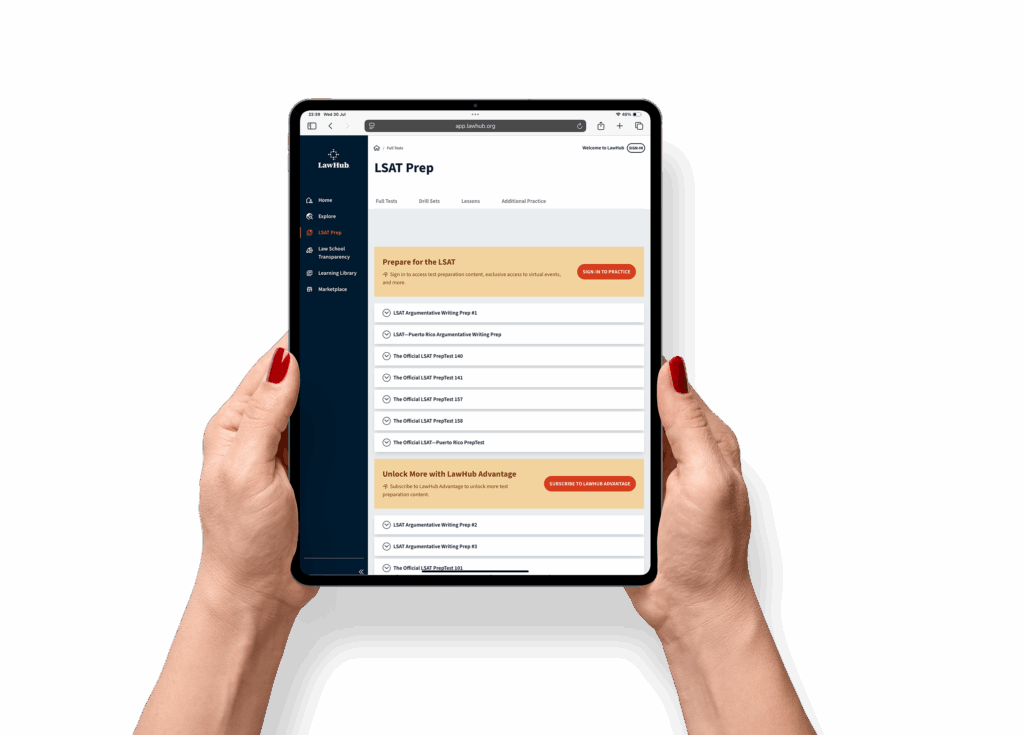
LSAT PRACTICE
Practice for the LSAT
Visit LawHub to access official LSAT practice materials—regular practice is a valuable way to build familiarity and confidence for test day.
Useful links
A collection of useful links for LSAT Prep.
We have collected some useful links that might help you in your preparation for taking the LSAT here.

Glossary
LSAT 101
Logical Reasoning – The puzzle of reading and understanding arguments so you can spot what’s right or wrong. Think of it as your mental gym for sharp thinking!
Reading Comprehension – Your chance to decode passages and get the main idea, almost like being a detective uncovering secrets in a story.
Logical Flaw – A sneaky mistake in an argument that you can spot if you look closely. It’s like finding the slip-up in a friend’s story. Think about it this way: the difference between the evidence and the conclusion of an argument.
Assumption – The hidden leap in logic that unlocks an argument. Spotting assumptions is like being a mind reader!
Conclusion – The main point or final idea in an argument. Like the punchline of a good joke, it’s what the argument is building toward. It is the thing supported by the evidence.
Premise – The supporting facts or reasons that lead to the conclusion. Think of it as the backbone of an argument, or another word for “evidence.”
Counterexample – A cool way to test if an idea really works by trying to find an exception. It’s like playing “what if” with scenarios.
Inference – The conclusion you draw that isn’t spelled out directly but is strongly implied. Like those “aha!” moments when everything clicks.
Question Stem – The part of a question that tells you what you need to find or do. It’s like the “clue” in a treasure hunt!
Time Management – Your game plan for pacing yourself so you can conquer all sections without rushing. It helps keep you calm and confident.
Practice Test – A mock exam that prepares you for the real deal. It’s like rehearsal for your big performance!
Elimination Strategy – Crossing out obviously wrong answers to narrow down your choices. Think of it as playing a game of “hot or cold.”
Guessing Smart – When you’re stuck, choosing the best possible answer can be a smart move. It’s about making educated guesses without stress.
Stress Relief – Techniques to stay chill and focused during study prep and the exam day. Because a relaxed mind is a winning mind!
FAQS
A collection of the most commonly asked questions
Below we have collated a collection of the questions we get asked most requently. If you have a question that is not here feel free to get in touch.
What is Arrow LSAT and who is it for?
Arrow LSAT is a focused LSAT prep service that helps students build the skills, timing, and confidence needed to reach their target scores. We work with first-time takers, repeat test-takers, busy professionals, and anyone who wants a smarter, more efficient path to a better LSAT — basically anyone who’d prefer aiming their shot instead of guessing where it will land.
Who are your tutors and what qualifications do they have?
Our tutors are experienced instructors and high-performing LSAT veterans — many are law grads, PhD candidates, or professional test-prep instructors who scored in the top percentiles. But beyond scores, we hire people who can teach: clear explanations, reliable lesson structure, and real empathy for the stress of standardized tests.
What types of prep do you offer (private, group, bootcamp)?
We offer private, online, one-on-one tutoring. We preach the tried and true approach of timed practice with detailed, actionable feedback — no fluff, more results.
When should I start studying for the LSAT?
If you’re starting from scratch, aim for 3–6 months of steady study to build fundamentals and timing. If you already have a strong baseline and need targeted improvement, 6–12 weeks of focused prep can deliver meaningful gains.
How long will it take to improve my score?
That depends on your starting point, how many hours you study per week, and how consistent you are. With guided tutoring and disciplined practice, many students see noticeable improvement within 6–12 weeks. Think of it like training for a sprint: you’ll see most gains when practice is structured, frequent, and followed by clear feedback.
Do you guarantee a specific score or offer refunds?
We don’t promise miracles — LSAT outcomes depend on effort, baseline skill, and how closely you follow the program. Beware guarantees that simply offer you the ability to take the course again for free after it didn’t work for you the first time.
How do you match a student with the right tutor?
We start with a short diagnostic and a conversation about goals, learning style, and schedule. Then we match you with a tutor whose expertise and personality best fit.
What happens in a typical tutoring session?
After the three introductory sessions that most of our students are expected to complete, 100% of your time with us will be spent reviewing full, timed tests that you have taken – and hopefully already reviewed once – on your own.
Do you use official LSAT materials?
Yes. We build our program around official LSAC PrepTests and other licensed materials whenever possible, supplemented by our own drills and explanations to target common weaknesses. Official tests are the best practice — they replicate real phrasing, pacing, and difficulty — and you should accept no imitations.
Can you help me with timing and test-day strategies?
Absolutely. A huge part of improvement is pacing, section management, and mental stamina. We work on timing drills, skip-and-come-back strategies, stress-management techniques, and full-length simulated test days so the real exam feels like just another practice session — minus the snack table.
Is online tutoring as effective as in-person?
Yes. In many cases it’s more effective. Modern tools (screen sharing, live whiteboards, recorded sessions) let tutors show work clearly and let students re-watch explanations. Online also gives you scheduling flexibility and access to a wider pool of tutors — and yes, you can remain extraordinarily comfortable in sweatpants while improving your score.
How much does tutoring cost and are there package discounts?
For exact pricing, please check our Pricing page or contact our team. We’ll recommend the most cost-effective plan based on your goals and timeline.
What is your rescheduling/cancellation policy?
We try to be flexible; after all, life happens. We ask our students to have the courtesy of giving their tutor at least 24 hours notice before canceling a session, whenever possible.
Can ArrowLSAT help with law school applications or personal statements?
Our core focus is the LSAT and performance improvement. That said, many of our tutors have law-school admissions experience and can offer help with strategy, timelines, and personal-statement feedback. We do also offer full-service admissions consulting.
How do I get started?
Easy: sign up for a free consultation on our Contact page, take a short diagnostic test, and we’ll recommend a customized study plan and tutor match. From there you can book your first session and start practicing with purpose — arrow aimed, target acquired.
How does scheduling work?
You personally create your schedule with your tutor.
Are your tutors accessible during the week?
Within reason, yes. Most of our tutors are happy to reply to texts outside of session, and all of our tutors reply to student emails promptly.
Is LSAT tutoring worth the price?
Yes. Your LSAT score determines more than where you’ll be accepted. A quick Google search will show you that research indicates every additional point you score on the LSAT translates to approximately $10,000 in financial aid for law school.
Is it true your tutors find the LSAT fun? How is this possible?
Yes, it is true. No one really knows how it’s possible. You probably like something that someone else finds boring, right? Maybe? It’s weird. We know.
How long should I spend preparing for the LSAT?
Depending on your goals, the average student studies for about two to three months. Many students study for longer than that.
Is tutoring better than taking a class?
Yes. Having the exclusive, unbroken attention of an expert in a one-on-one setting is the best way to learn almost any skill.
I have been stuck at the same score for weeks or months. I feel stagnant. Why am I not improving?
This is part of the hazing ritual that is the LSAT. It is completely normal to feel as though you have reached the pinnacle of your abilities. We have helped hundreds of students break through this mental hurdle. The LSAT is not just about logical analysis – it’s about persistence. Mental tenacity. Perseverance. You can do this.